Instantly Calculate Your WBSEDCL Electricity Bill!
Tired of waiting for your quarterly bill to arrive? Take control of your electricity expenses today! Our simple and intuitive calculator is designed just for West Bengal consumers like you.
Here’s how easy it is:
- Enter Your Consumption: Just type in your total power consumption in units (kWh) for the period you want to check.
- Click “Calculate”: Hit the button and watch the magic happen!
Instantly, you’ll see a clear breakdown of your estimated WBSEDCL bill amount, including the base energy charges, fixed charges, and the final total payable amount. No more guesswork, just clear, accurate results.
A Quick Note on Quarterly Billing:
WBSEDCL sends a consolidated bill once every three months. This single bill includes the fixed charges for all three months combined. Our calculator is already set up to account for this three-month cycle to give you the most accurate estimate, so you don’t need to adjust anything!
For most homes, the “Maximum Demand” is not a major factor, so we’ve set it to zero by default. However, if you have a specific sanctioned load mentioned on your bill, you can easily update it for an even more precise calculation.
WBSEDCL Bill Calculator
Navigating the complexities of electricity billing can often be a daunting task for consumers. In West Bengal, where millions of households and businesses rely on the services of the West Bengal State Electricity Distribution Company Limited (WBSEDCL), understanding the nuances of the electricity bill is crucial for effective budget management. As the state ushers in a new fiscal year, a common query emerges among consumers: what are the new per-unit electricity rates for 2025-2026? This question stems from the annual revisions made to the tariff structure, which can significantly impact monthly expenditure.
The West Bengal Electricity Regulatory Commission (WBERC) has announced the tariff order for the 2025-2026 period, which came into effect on April 1, 2025. This has led to a surge in consumers searching for a reliable “West Bengal Electricity Bill Calculator” to understand how these new rates will affect their finances. An accurate calculator and a clear understanding of the updated rate chart are indispensable tools. They empower consumers to estimate their monthly electricity costs with precision, prevent billing surprises, and plan their energy consumption more efficiently. This article provides a comprehensive guide to the updated WBSEDCL tariff for 2025-2026, explains the various components of your bill, and offers a step-by-step method to calculate your expenses, ensuring you are well-equipped to manage your electricity usage and costs in the coming year.
WBSEDCL Electricity Bill Calculator
About WBSEDCL and the Electricity Tariff System
The West Bengal State Electricity Distribution Company Limited (WBSEDCL) is the primary public utility responsible for distributing electricity to a vast consumer base across the state of West Bengal, excluding the areas served by CESC in Kolkata. Formed in 2007, WBSEDCL has been instrumental in extending the power grid to rural and urban areas, managing a network that includes 20 regional offices, 5 zones, and over 74 distribution divisions to ensure efficient service delivery to its customers.
The pricing of the electricity that WBSEDCL supplies is not determined by the company itself but is regulated by an independent statutory body, the West Bengal Electricity Regulatory Commission (WBERC). Established under the Electricity Regulatory Commissions Act of 1998, the WBERC’s primary functions include determining the tariff for electricity generation, supply, transmission, and wheeling within the state. The commission’s mandate is to promote competition, efficiency, and economy in the electricity industry while also ensuring the viability of the power sector and protecting consumer interests.
Each year, WBERC undertakes a meticulous process to decide the tariff for the upcoming fiscal year. This process involves scrutinizing tariff petitions filed by distribution licensees like WBSEDCL. The commission evaluates various cost components, including the cost of power purchased from generating companies, transmission costs, operational and maintenance expenses, and a reasonable return on investment for the utility. After public hearings and stakeholder consultations, the WBERC issues a formal Tariff Order, which details the slab-wise rates for different consumer categories. For the fiscal year 2025-2026, the tariff became effective from April 1, 2025, based on the commission’s order dated March 20, 2025. Therefore, for any consumer wishing to estimate their upcoming bills accurately, it is essential to refer to these latest, officially declared rates rather than relying on outdated information.
Understanding West Bengal’s Dual Power Distribution System
West Bengal operates through two major electricity distribution companies: WBSEDCL and Calcutta Electric Supply Corporation (CESC). While both serve different regions, CESC primarily covers Kolkata and surrounding areas with premium pricing, whereas WBSEDCL serves the broader state territory with more affordable rates.
WBSEDCL manages the electricity distribution across most districts, operating under state ownership to provide reliable power supply and infrastructure maintenance. Its extensive service network covers both rural and urban areas, supporting various consumer categories from households to large industries. Meanwhile, CESC specifically serves Kolkata and Howrah, focusing on these densely populated urban centers.
West Bengal Electricity Per Unit Rate 2025–2026 (Latest Update)
Understanding the latest tariff structure is the first step toward accurately calculating your electricity expenses. The WBERC has laid out a detailed slab-based system for different categories of consumers for the fiscal year 2025-2026. The rates vary for residential (domestic), commercial, and industrial connections, and even within the residential category, there is a distinction between rural and urban areas.
It’s important to note that billing is often done on a quarterly basis, but the tariff slabs are defined for monthly consumption. Therefore, for a quarterly bill, your total consumption over the three months is averaged to a monthly figure to apply these slabs.
Residential (Domestic) Tariff Slabs
For the fiscal year 2025-2026, the WBERC has approved the following per-unit energy charges and fixed charges for domestic consumers. These rates are net of a government subsidy provided for consumers with a monthly consumption of up to 300 units.
WBSEDCL Domestic (Rural) Tariff – 2025-2026
| Monthly Consumption Slab (kWh) | Net Rate Per Unit (Paisa/kWh) | Net Rate Per Unit (₹/kWh) | Fixed Charge (₹/kW/Month) |
|---|---|---|---|
| First 102 Units | 410 | ₹ 4.10 | ₹10 |
| Next 78 Units (103-180) | 534 | ₹ 5.34 | ₹10 |
| Next 120 Units (181-300) | 615 | ₹ 6.15 | ₹20 |
| Next 300 Units (301-600) | 665 | ₹ 6.65 | ₹20 |
| Above 600 Units | 681 | ₹ 6.81 | ₹20 |
Source: Based on WBERC Tariff Order Gist for 2025-26.
WBSEDCL Domestic (Urban) Tariff – 2025-2026
Urban consumers face slightly different rates compared to their rural counterparts.
| Monthly Consumption Slab (kWh) | Net Rate Per Unit (Paisa/kWh) | Net Rate Per Unit (₹/kWh) | Fixed Charge (₹/kW/Month) |
|---|---|---|---|
| First 102 Units | 415 | ₹ 4.15 | ₹10 |
| Next 78 Units (103-180) | 537 | ₹ 5.37 | ₹10 |
| Next 120 Units (181-300) | 638 | ₹ 6.38 | ₹20 |
| Next 300 Units (301-600) | 673 | ₹ 6.73 | ₹20 |
| Above 600 Units | 689 | ₹ 6.89 | ₹20 |
Source: Based on WBERC Tariff Order Gist for 2025-26.
In addition to these rates, consumers under the “HASIR ALO” scheme for lifeline domestic connections (up to 75 units quarterly) benefit from a special tariff.
Commercial & Industrial Rates
Commercial and industrial tariffs are structured differently, often based on the voltage level of the connection and the total load. These rates are generally higher than domestic tariffs and do not receive the same level of government subsidy.
LT & HT Commercial / Industrial Tariff (As per latest available data)
| Category | Sanctioned Load | Rate Per Unit (Indicative) | Fixed/Demand Charge (Indicative) |
|---|---|---|---|
| LT Commercial | 0-5 kW | ₹ 7.33 | ₹ 60 / kW / month |
| MT Commercial | 5-50 kW | ₹ 7.68 | Varies |
| HT Industrial | Above 50 kW | ₹ 8.12 | Varies |
Source: Based on rates for 2024-25, with updates for 2025.
It’s crucial for commercial consumers to note that additional charges, such as a 25% surcharge for consumption during peak hours (e.g., 5 PM to 11 PM), may apply. Furthermore, a rebate of 2 paisa/kWh may be applicable for some commercial consumers in rural areas.
Latest Tariff Structure for 2025-26: What’s New?
The West Bengal Electricity Regulatory Commission has announced revised tariff rates for the fiscal year 2025-26, designed to balance consumer affordability with infrastructure development needs. The Commission has determined the Aggregate Revenue Requirement (ARR) for multiple years under the eighth control period, establishing detailed tariff schedules with related conditions and wheeling charges.
Domestic Rural Consumer Rates (LT Category)
Rural households enjoy the most affordable electricity rates under WBSEDCL’s progressive slab system:
For rural domestic consumers, the tariff structure includes: ₹4.10 per unit for consumption between 0-102 units, ₹5.34 per unit for 102-180 units, ₹6.15 per unit for 181-300 units, ₹6.65 per unit for 301-600 units, and ₹6.81 per unit for consumption above 600 units. The fixed charge remains at ₹20 per kVA per month, providing stability in billing.
Domestic Urban Consumer Rates
Urban consumers pay slightly higher rates with ₹4.15 per unit for 0-102 units (₹0.05 more than rural tariff), ₹5.37 per unit for 102-180 units, ₹6.38 for 181-300 units, ₹6.73 for 301-600 units, and ₹6.89 per unit for consumption above 600 units. This marginal difference reflects the higher infrastructure costs in urban areas.
Commercial Consumer Categories
Commercial establishments in rural areas pay ₹4.31 for 0-60 units, ₹4.72 for 61-100 units, ₹4.92 for 101-300 units, and ₹5.05 per unit for consumption above 300 units. Commercial consumers also face a higher fixed charge of ₹30 per kVA per month, reflecting their typically higher power demands.
Special Schemes and Government Subsidies
“Hasir Alo” Scheme: A Ray of Hope for Low-Income Households
The West Bengal government’s “Hasir Alo” scheme offers a significant subsidy for eligible low-income households, providing free electricity for consumption up to 75 units per quarter. This initiative aims to alleviate the financial burden on economically weaker sections. To avail of this benefit, eligible consumers need to enroll in the scheme through their nearest electricity office or at a ‘Duare Sarkar’ camp.
West Bengal Electricity Bill Calculator (Step-by-Step Guide)
While an automated online tool is the easiest way to estimate your bill, knowing how to calculate it manually gives you a clearer understanding of your expenses. The calculation involves breaking down your total consumption into the tariff slabs and then adding the fixed and other charges.
Here’s a step-by-step guide to manually calculating your WBSEDCL electricity bill:
- Note Your Total Unit Consumption:
First, determine the total number of units (kWh) you have consumed during the billing period. For a quarterly bill, you will typically find the total consumption for three months. To use the monthly tariff slabs, divide this total consumption by three to get your average monthly consumption. - Apply the Slab Rates:
Take your average monthly consumption and distribute it across the applicable tariff slabs for your category (e.g., Domestic Urban).- Calculate the cost for the first 102 units.
- If your consumption is higher, calculate the cost for the next 78 units.
- Continue this process for each slab until all your consumed units are accounted for.
- Sum the Slab Charges to Get Energy Charge:
Add the amounts calculated for each slab. This total is your Energy Charge for one month. - Add Fixed Charges, Duty, and Other Charges:
- Fixed Charge: Add the monthly fixed charge, which depends on your sanctioned load. For most domestic connections, this is based on the slabs as shown in the tables above.
- Electricity Duty: This is a tax levied by the state government. It is typically calculated as a percentage of your energy charge and fixed charge.
- Monthly Variable Cost Adjustment (MVCA): WBSEDCL is permitted to recover variations in fuel and power purchase costs through the MVCA, which is applied per unit of energy consumed. This is shown separately on the bill.
- Meter Rent: A nominal monthly charge for the meter installed at your premises.
- Calculate the Total Bill:
To get the total bill for a single month, sum up the Energy Charge, Fixed Charge, Electricity Duty, and Meter Rent. For a quarterly bill, multiply this monthly total by three.
This manual process gives you a transparent view of how your final bill amount is derived from the base unit rates.
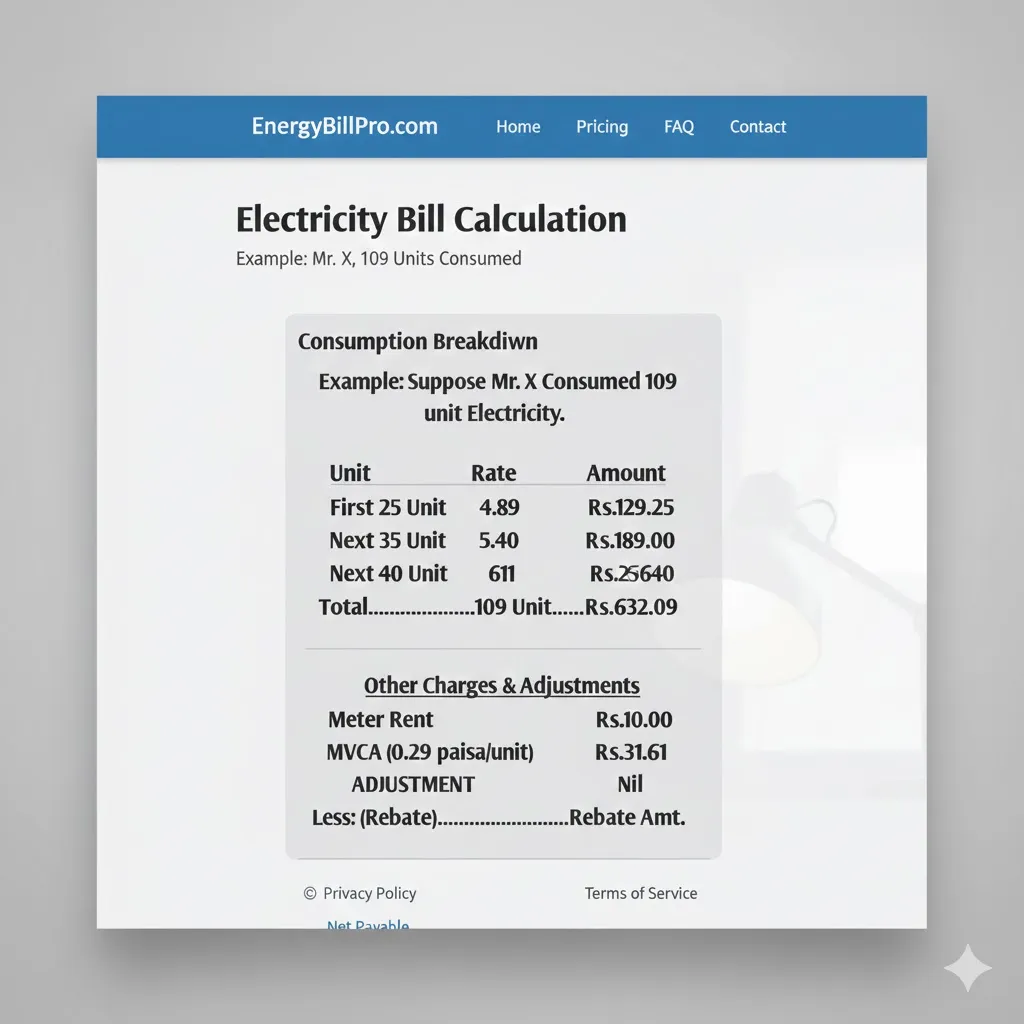
Example Calculation
Let’s walk through a practical example to demystify the manual calculation process. We will calculate the estimated monthly bill for a Domestic (Urban) consumer with a monthly consumption of 250 units.
Assumptions:
- Total Monthly Consumption: 250 kWh
- Consumer Category: Domestic (Urban)
- Sanctioned Load: Up to 5 kW (covered by the slab-based fixed charge)
Here is the breakdown based on the 2025-2026 Urban tariff:
- Slab 1 (First 102 units):
- Units: 102 kWh
- Rate: ₹ 4.15 per unit
- Cost = 102 * 4.15 = ₹ 423.30
- Slab 2 (Next 78 units, i.e., from 103 to 180 units):
- Units: 78 kWh
- Rate: ₹ 5.37 per unit
- Cost = 78 * 5.37 = ₹ 418.86
- Slab 3 (Next 120 units, i.e., from 181 to 300 units):
- Our remaining units are 250 – 102 – 78 = 70 units.
- Units: 70 kWh
- Rate: ₹ 6.38 per unit
- Cost = 70 * 6.38 = ₹ 446.60
- Total Energy Charge:
- Sum of all slab costs = ₹ 423.30 + ₹ 418.86 + ₹ 446.60 = ₹ 1288.76
- Add Fixed Charges:
- For consumption between 181-300 units, the fixed charge is ₹20 per month.
- Fixed Charge = ₹ 20.00
- Add Electricity Duty and Meter Rent:
- Let’s assume an Electricity Duty of 10% on the sum of energy and fixed charges.
- Duty = 10% of (₹ 1288.76 + ₹ 20.00) = 10% of ₹ 1308.76 = ₹ 130.88
- Let’s assume a Meter Rent of ₹ 15.00 per month.
- Meter Rent = ₹ 15.00
- Calculate Final Estimated Monthly Bill:
- Total Bill = Energy Charge + Fixed Charge + Electricity Duty + Meter Rent
- Total Bill = ₹ 1288.76 + ₹ 20.00 + ₹ 130.88 + ₹ 15.00 = ₹ 1454.64
Therefore, the estimated monthly electricity bill for a 250-unit consumption in an urban area would be approximately ₹ 1,455. For a quarterly bill, this amount would be multiplied by three. Note that the final bill may vary slightly due to the applicable MVCA.
Special Schemes and Initiatives
Green Energy Initiatives
For environmentally conscious consumers, WBSEDCL offers a ‘Green Tariff’ at 50 paise/kWh over the regular retail tariff for those consuming minimum 25% green power for at least six months uninterrupted. Requisitions must be made in multiples of 25% of total consumption.
Green Energy Options
For the year 2025-26, promotional single part tariff for Electric Vehicle Charging Stations at Rs. 6.00 per unit during ‘peak’ hours (17:00 hrs to 23:00 hrs) and Rs. 5.50 per unit during ‘other than peak’ hours shall continue. This initiative supports the state’s electric mobility vision while ensuring sustainable transportation infrastructure development.
The green tariff option enables environmentally conscious consumers to support renewable energy generation. Any EV Charging Station has the liberty to go for complete green resource by applying for green energy with payment of Green Tariff. This flexibility allows businesses to align their operations with sustainability goals while contributing to carbon emission reduction.
Time-of-Day (TOD) Tariff Benefits
Time-of-Day tariff structures incentivize consumption during off-peak hours, helping flatten the demand curve and improve grid stability. Industrial consumers particularly benefit from TOD tariffs by scheduling energy-intensive operations during lower-rate periods. The differential pricing mechanism can result in significant cost savings for consumers able to shift their consumption patterns.
The TOD structure typically defines peak hours (usually evening hours when residential demand peaks) and off-peak periods (late night and early morning hours). Some utilities also identify shoulder periods with intermediate rates. Smart meters enable accurate TOD billing by recording consumption with timestamps, ensuring precise application of time-based rates.
Electric Vehicle Charging Support
The promotional tariff for Electric Vehicle Charging Stations continues at ₹6.00 per unit during peak hours (17:00-23:00 hrs) and ₹5.50 per unit during off-peak hours, encouraging the adoption of electric vehicles.
WBSEDCL Bill Components Explained
Energy Charge
The energy charge forms the primary component of your electricity bill, calculated based on actual consumption measured in kilowatt-hours (kWh). This variable charge directly correlates with your usage patterns, making it the most controllable aspect of your electricity expenses. The slab-wise structure ensures progressive pricing, where higher consumption attracts elevated rates.
Fixed Charge
Fixed charges represent the infrastructure and service availability costs, remaining constant regardless of consumption levels. These charges contribute to maintaining the distribution network, customer service operations, and ensuring reliable power supply. For domestic consumers, fixed charges remain minimal, while commercial and industrial users pay based on their contracted load capacity.
Electricity Duty
All statutory levies like Electricity Duty or any other taxes, duties etc. imposed by the State Govt. / Central Govt. or any other competent authority shall be extra. This government-imposed levy contributes to state revenue and varies across different consumer categories. The duty calculation typically applies to the total energy charges, excluding fixed charges and other components.
Meter Rent
Consumers using specialized meters, particularly those with higher accuracy requirements or advanced features, pay monthly meter rent. Standard domestic meters usually don’t attract rental charges, but commercial establishments with electronic or smart meters may face nominal monthly fees. This charge covers meter maintenance, periodic calibration, and eventual replacement costs.
Late Payment Surcharge
Timely bill payment remains crucial to avoid additional charges. Late payment surcharges apply when consumers fail to settle their bills within the due date specified on the bill. These charges, typically calculated as a percentage of the outstanding amount, accumulate daily until payment completion. The surcharge serves as both a deterrent against delayed payments and compensation for the utility’s working capital costs.
Monthly Variable Cost Adjustment (MVCA)
The rates exclude the Monthly Variable Cost Adjustment (MVCA) realized by WBSEDCL, which is subject to truing up during FPPCA and APR for the year as per provision of Tariff Regulation. This mechanism allows utilities to recover variations in power purchase costs without frequent tariff revisions, ensuring financial sustainability while protecting consumers from sudden price shocks.
Example Calculation
Let’s walk through a detailed calculation for a typical household consuming 250 units per month in a rural area:
Step 1: Calculate Energy Charges
- 0-102 units: 102 units × ₹4.10 = ₹418.20
- 102-180 units: 78 units × ₹5.34 = ₹416.52
- 180-250 units: 70 units × ₹6.15 = ₹430.50
- Total Energy Charge: ₹1,265.22
Step 2: Add Fixed Charges
Assuming a standard domestic connection with 2 kW sanctioned load:
- Fixed Charge: ₹25.00 per month (indicative)
Step 3: Calculate Fuel Surcharge
- 250 units × ₹0.29 = ₹72.50
Step 4: Apply Electricity Duty
- 10% of Energy Charges: ₹1,265.22 × 0.10 = ₹126.52
Step 5: Total Bill Calculation
- Energy Charges: ₹1,265.22
- Fixed Charges: ₹25.00
- Fuel Surcharge: ₹72.50
- Electricity Duty: ₹126.52
- Grand Total: ₹1,489.24
This example demonstrates how various components contribute to the final bill amount. Understanding each element helps consumers identify areas for potential savings and verify billing accuracy.
Durgapur Projects Limited (DPL) Area: Special Tariff Zone
Former DPL consumers enjoy a distinct tariff structure: ₹3.45 for 0-25 units, ₹4.20 for 25-50 units, ₹4.35 for 50-100 units, ₹4.67 for 100-200 units, ₹4.86 for 200-300 units, and ₹4.99 for consumption above 300 units. The fixed charge is set at ₹15 per kW/kVA, lower than standard WBSEDCL rates.
Practical Bill Calculation Example
Let’s calculate a typical household bill for 560 units of rural consumption:
Energy Charges Breakdown:
- First 102 units: 102 × ₹4.10 = ₹418.20
- Next 78 units (102-180): 78 × ₹5.34 = ₹416.52
- Next 120 units (181-300): 120 × ₹6.15 = ₹738.00
- Next 260 units (301-560): 260 × ₹6.65 = ₹1,729.00
- Total Energy Charges: ₹3,301.72
Additional Components:
- Fixed Charges (1kW × 3 months): ₹60.00
- MVCA Charges (560 × ₹0.29): ₹162.40
- Electricity Duty (10% of energy charges): ₹330.17
- Meter Rent (3 months): ₹45.00
- Total Bill Amount: ₹3,899.29
CESC Electricity Rates for 2025-2026
CESC, serving Kolkata and adjacent areas, also has a slab-based tariff system. While the official tariff order for 2025-26 provides detailed figures, consumers can expect a slight premium on rates compared to WBSEDCL.
For the most accurate and up-to-date tariff information for CESC, consumers are advised to refer to the official WBERC website or their latest electricity bill. CESC has also proposed a potential hike in tariffs for the 2025-26 fiscal year, though the final approved rates are subject to the regulatory commission’s decision.
Power Subsidy for Micro, Small, and Medium Enterprises (MSMEs)
To encourage industrial growth, the West Bengal government offers a power subsidy to MSMEs under the “Banglashree for Micro, Small and Medium Enterprises” scheme. This initiative provides a subsidy on the electricity tariff for a period of five years from the commencement of commercial production. The subsidy amount varies based on the enterprise’s location.
Digital Payment Revolution
Modern payment platforms like Bajaj Pay provide secure BBPS-enabled transactions, making bill payment convenient and rewarding through cashback offers. WBSEDCL’s own online portal offers multiple payment options including net banking, debit/credit cards, and UPI, with automatic rebate applications for eligible transactions.
Energy Saving Tips for Consumers
Reducing your electricity consumption is the most direct way to lower your monthly bills. With rising energy costs, adopting energy-efficient habits and technologies is not just good for your wallet but also for the environment. Here are some practical tips to effectively reduce your electricity usage:
Smart Lighting and Fans:
- Switch to LEDs: Replace all incandescent bulbs and old tube lights with energy-efficient LED bulbs. LEDs consume up to 80% less energy and last much longer.
- Use Natural Light: Rearrange your rooms to make the most of natural daylight, reducing the need for artificial lighting during the day.
- Clean Fixtures: Regularly clean your light fixtures and bulbs. Dust can reduce illumination by up to 30%, making you switch on more lights than necessary.
- Install BLDC Fans: Replace conventional ceiling fans with Brushless Direct Current (BLDC) motor fans, which can consume significantly less power.
- Use Electronic Regulators: Old, humming fan regulators waste energy as heat. Switch to modern, step-type electronic regulators.
Efficient Appliance Usage:
- Choose BEE 5-Star Appliances: When buying new appliances like refrigerators, air conditioners, or geysers, always opt for those with a 5-star rating from the Bureau of Energy Efficiency (BEE). They are designed for lower power consumption.
- Unplug “Vampire” Devices: Many electronic devices, like TVs, chargers, and set-top boxes, draw power even when turned off. This is called “phantom load” or “vampire energy”. Unplug them or use a power strip with a master switch to cut off power completely.
- Maintain Your Refrigerator: Ensure the rubber seal (gasket) on your fridge door is clean and tight. Avoid opening the door frequently and defrost it regularly if it’s not a frost-free model.
- Optimize AC Usage: Clean the filters of your air conditioner every fortnight. Set the thermostat to a comfortable 24-26°C instead of the lowest temperature. Using the AC for one hour less each day can lead to significant savings.
Smart Meter Benefits:
- WBSEDCL is rolling out smart meters in various areas. These meters provide real-time consumption data, helping you track your usage patterns and identify which appliances are consuming the most power. This detailed insight allows you to make informed decisions to optimize usage and save money. Some areas are also shifting to monthly billing from quarterly, which can provide a more predictable payment cycle.
General Habits:
- Switch Off When Not in Use: Cultivate the habit of switching off lights and fans when leaving a room, even for a few minutes.
- Mindful Kitchen Use: Only boil as much water in your kettle as you need. Use smaller pans that fit the stove burner and keep lids on to cook food faster, saving gas or electricity.
- Check Your Wiring: In older homes, faulty or outdated wiring can lead to energy leakage. It’s advisable to have your meter and internal wiring checked by a qualified electrician if you notice unusually high bills.
Future Outlook and Smart Grid Integration
With the implementation of smart meters, monthly billing cycles will be introduced with slab quantities computed as one-third of quarterly slabs, enabling more accurate consumption tracking. This digital transformation promises enhanced billing transparency, real-time usage monitoring, and improved demand response capabilities.
Online Payment & Bill View Options
How to Check Your WBSEDCL Bill Online
WBSEDCL has made it convenient for consumers to manage their accounts online, eliminating the need to stand in long queues. You can view your bill, track your payment history, and make payments from the comfort of your home.
How to Check Your WBSEDCL Bill Online:
- Visit the official WBSEDCL website (
wbsedcl.in). - Navigate to the “Consumer Corner” or look for a “View Bill” option.
- You will need your unique Consumer ID and sometimes the Installation Number, both of which are printed on your physical electricity bill.
- After entering the required details and a captcha for verification, you can view your latest bill, including the total amount due and the due date.
WBSEDCL “Vidyut Sahayogi” Mobile App:
For even greater convenience, WBSEDCL has a mobile app called “Vidyut Sahayogi”. The app allows you to register your consumer account, view bills, make payments, and even register complaints on the go. You can download it from the Google Play Store.
Online Payment Process & Accepted Modes:
WBSEDCL offers a “Quick Pay” option for making payments without needing to log in. The process is straightforward:
- Go to the “Online Payment” section on the WBSEDCL website.
- Select the “Quick Pay” or “Postpaid Energy Bill” option.
- Enter your Consumer ID and the captcha code.
- The system will display your name and the total outstanding amount.
- Click “Pay Bill” and you will be redirected to a secure payment gateway like Billdesk.
- You can complete the payment using various modes, including:
- UPI (Unified Payments Interface)
- QR Code
- Net Banking
- Debit Cards
- Credit Cards
- Mobile Wallets
Upon successful payment, you will receive a digital receipt which can be saved or printed for your records.
Important Note on Recent Payment System Changes:
Recent updates to the WBSEDCL online portal have changed how payments are processed. As of late 2025, consumers may notice that they can no longer select specific past months to pay for; the system shows a consolidated outstanding amount. This change has also temporarily affected payments through some third-party apps like Google Pay and PhonePe, which may show the service as down. The likely purpose of this new system is to facilitate partial payments online, a feature previously available only at physical offices. Consumers should be aware of these changes when making online payments.
Regulatory Framework and Consumer Protection
All statutory levies including Electricity Duty and taxes imposed by State/Central Government remain separate from base tariff rates and are clearly itemized on bills for transparency. The West Bengal Electricity Regulatory Commission ensures fair pricing through periodic reviews while maintaining service quality standards.
Conclusion
The introduction of the new electricity tariff for 2025-2026 by the WBERC marks a critical update for every WBSEDCL consumer. The revised slab rates and charges directly influence your monthly budget, making it more important than ever to understand how your bill is calculated. By familiarizing yourself with the updated domestic and commercial rate charts, you can accurately forecast your expenses and avoid surprises.
Remember that the final tariff is a result of a regulated process that balances the operational costs of the utility with the interests of the consumer. These rates are subject to annual revision, reflecting the dynamic nature of power purchase costs and other economic factors. By using the manual calculation methods described or an online calculator, you can gain a transparent view of your energy spending. Coupled with the energy-saving tips provided, this knowledge empowers you to take control of your consumption and contribute to a more sustainable future.
Bookmark this page to get updated rates and insights every year.
Frequently Asked Questions (FAQ Schema-Ready)
What is the electricity rate per unit in West Bengal 2025–2026?
For the 2025-2026 fiscal year, the net subsidised rate for domestic (urban) consumers starts at ₹4.15 per unit for the first 102 units and increases with higher consumption slabs. For domestic (rural) consumers, it starts at ₹4.10 per unit for the same slab. Commercial rates are higher and start from around ₹7.33 per unit
How can I pay my WBSEDCL bill without logging in?
You can use the “Quick Pay” facility on the official WBSEDCL website. This feature allows you to make a payment by simply entering your Consumer ID and the verification captcha, without needing to go through a full login process.
What is the fixed charge for domestic consumers?
The fixed charge for domestic consumers for the 2025-2026 period is ₹10 per month for consumption up to 180 units and ₹20 per month for consumption above 180 units. This charge is levied per kilowatt (kW) of sanctioned load.
How to calculate my WBSEDCL electricity bill manually?
To calculate your bill, first find your total monthly consumption in kWh. Break this consumption down according to the tariff slabs for your category (rural/urban domestic). Multiply the units in each slab by its specific rate. Sum up these costs to get the ‘Energy Charge’. Finally, add the ‘Fixed Charge’, ‘Electricity Duty’, ‘MVCA’, and ‘Meter Rent’ to get the total estimated bill
Does WBSEDCL have different rates for rural and urban users?
Yes, WBSEDCL has slightly different tariff structures for domestic consumers in rural and urban areas. Generally, the per-unit rates for urban consumers are marginally higher than for rural consumers across all consumption slabs.